


In last month’s newsletter, Whitney Elkins-Hutten, our Director of Investor Education, published an article about how you can 1031 into a passive syndication. This month, I’d like to share with you how we utilize the 1031 structure to continue to grow your investments and defer the capital gains until you die. This is a very important part of real estate investing and you will see that we are here for you all along the way.
1031 and a Syndication
On my calls with investors, I often get asked, “Can you do a 1031 Exchange (commonly referred to as just “1031”) with an apartment syndication with a group of investors?”
The apartment syndication structure does make it more challenging to do a 1031 but it can certainly be done. There are things that must be done when setting up the entity and a process to follow when we begin to ensure a smooth exchange when we sell the underlying asset.
Our group does plan to do a 1031 on each asset when we sell and those that want to get out do have that option. We cannot guarantee that we will be able to complete the 1031 exchange as there is a certain timeline that must be followed for it to work properly according to the IRS guidelines (see the graphic below for details on the timeline for properly executing a 1031).
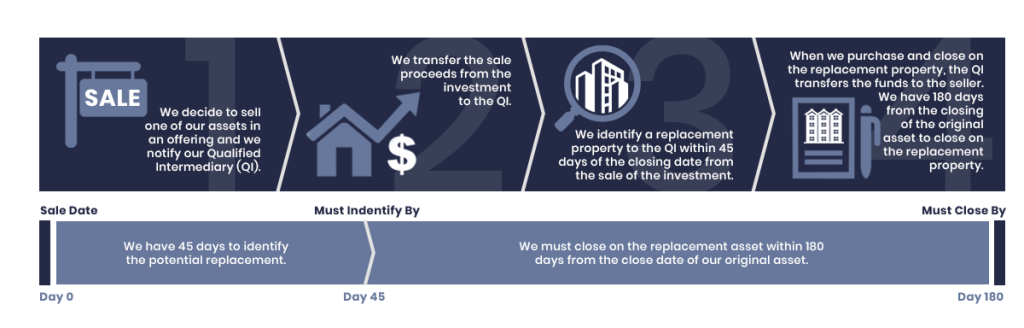
When we sell an asset, the next property must be identified within 45 days of closing. We must then close on the new property within 180 days from closing in order to qualify.
There is also the potential that the IRS changes their guidelines which completely removes or makes the process more challenging for the 1031. I think the latter is more likely given the fact that it would cause a major impact on the real estate market if the 1031 option was completely removed altogether. This could certainly occur when there is a change in the presidency.
The Legacy Wealth Play – Never Pay Real Estate Capital Gains Tax Again
One of the major benefits of doing the 1031 exchange is the ability to defer the capital gains tax. However, eventually you will pay the capital gains tax if you sell and take the proceeds out instead of opting for the 1031.
If you can continue to 1031 until you die, the basis in the property will reset to the current value of the investment when you die as the investment is handed down to your children. Therefore I like to call the 1031 a “legacy wealth play” as this allows to you to never pay capital gains and to leave more to your family when you pass away.
Why Does Your Group Trouble Yourself with Doing the 1031 for Your Investors?
One of our goals is to continue to have you invest with us deal after deal for many decades. We want you to be with us for the long haul and not just a one-off investment. Danny and I have our own money invested alongside you in each offering that we structure. We both want to continue to build our wealth and bring as many of you along with us to continue to build substantial family legacy wealth to provide for many generations that may come after we leave this World.
Why Most Groups Don’t Offer the 1031 Option?
Most groups choose not to do a 1031 at the end of their deals for their investors because it takes more time, energy, and effort to complete the transaction.
My wife and I have personally invested in 80+ different passive syndications with 18 different operators. One of the things that I have noticed with the various operators is that most of them do not want to take on the extra responsibility and add the effort to invest for the long haul by allowing their investors to utilize the 1031 option from one asset to the next.
Why my Wife and I Invest with Other Operators?
One of the reasons why we invest with so many other operators, is that it allows us to see what others are doing so we can continue to improve our own operations for you as one of our trusted investors. Most of what we have learned is things not to do to our investors, but every investment provides different perspectives especially in the times that we are living with so much uncertainty in the market.
Successful Business Background is Important
In my seven red flags for passive real estate investing article, that I published a few months ago (HINT: I’ve now added an 8th red flag and will be discussing this in my next article), I discussed how it is uber important to invest with an operator with a successful background in business. We are seeing now from our own passive investments which operators are doing the right thing based on their prior business experience and which ones are not handling the economic turmoil properly.
Thankfully 95% of our personal passive investments are being handled in a proper way since we keep to our word in only investing with operators that have this background in business. We don’t want to invest with a newer operator that has little-to-no business experience. We don’t want anyone learning how to run a business with our hard-earned capital at risk.
If you have any investments outside of PassiveInvesting.com, you probably have experienced some of what I am talking about in regard to knowing which operators have business experience and which ones do not. Now, don’t get me wrong here. I am not saying that everything we do is perfect, but we always try to leverage our multiple decades of business, finance, and real estate experience to do our best to properly navigate the storms ahead.
